
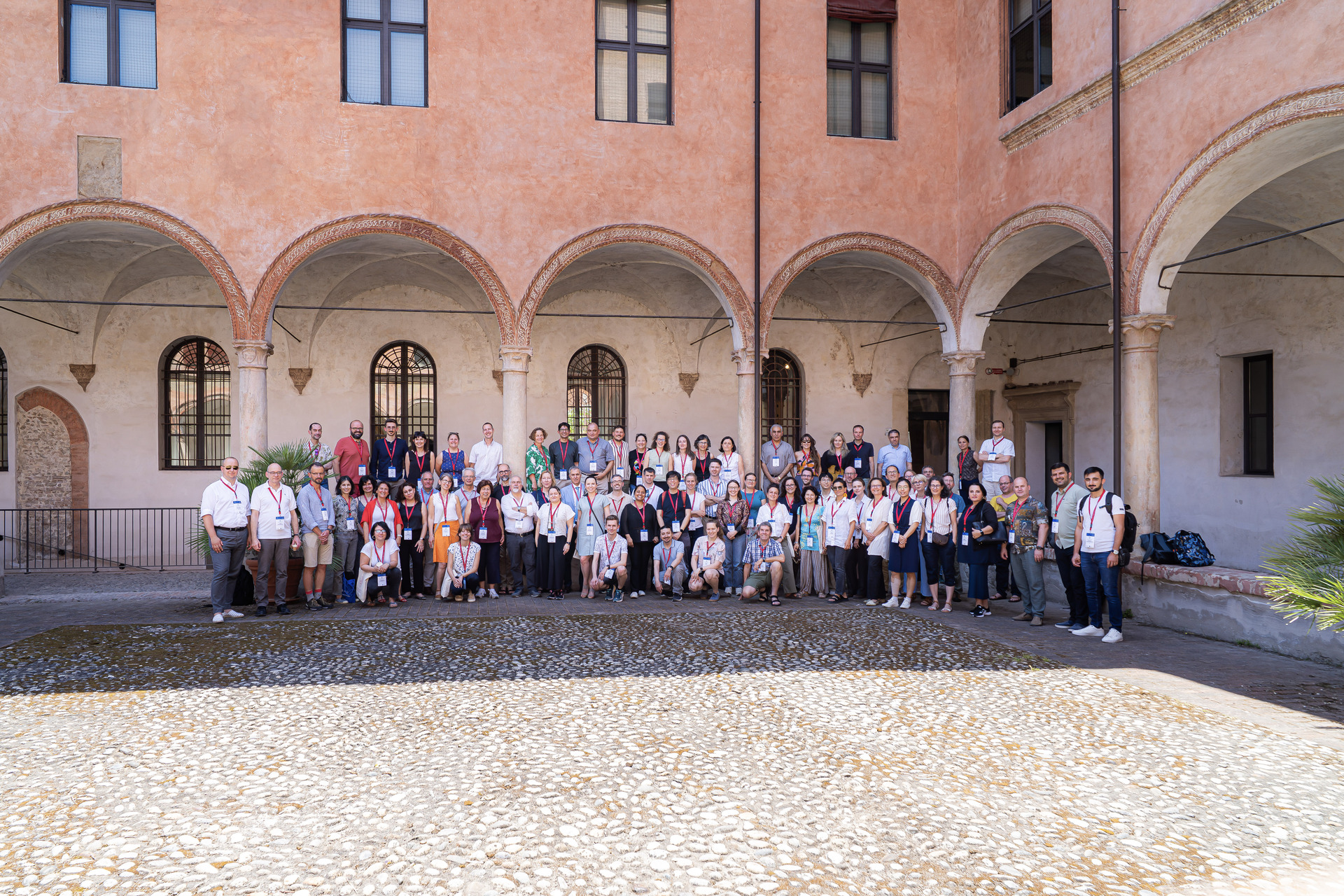
CLEANFOREST comes together in Bologna for its Final Annual Meeting
The Chair of the Action, Rossella Guerrieri, hosted the final CLEANFOREST Annual Meeting in the beautiful setting of the Complesso di Santa Cristina at the Alma Mater Studiorum, University of Bologna.
Over three intense days, 184 participants joined us on-site and online for a programme combining scientific exchange, networking, Working Group discussions, stakeholder perspectives and opportunities to reflect on the legacy and future of CLEANFOREST.
The first day was dedicated to Working Group meetings, giving participants, both on-site and online, the opportunity to work together on ongoing activities and deliverables. The sessions provided dedicated time to discuss progress, advance manuscripts and analyses, and coordinate the next steps for the different activities developed across the Action.
The second day was dedicated to the CLEANFOREST conference on Towards resilient European forests under climate extremes and atmospheric deposition: from fragmentation to integration, bringing together the different strands of research developed within the Action and connecting them with broader perspectives on forest management and policy across Europe.
Following a brief welcome from the Chair, Rossella Guerrieri, and the President of the Italian Society of Silviculture and Forest Ecology, Giorgio Matteucci, the conference opened with the session Scientific Achievements of CLEANFOREST: key results from the working groups, moderated by Elena Vanguelova and Andrei Popa. WG leaders, co-leaders and members presented some of the key scientific outcomes emerging from the Action:
- Climate hotspots affecting European forests (Mário Gonzalez Pereira, WG1)
- Long-term hotspots of drought and air pollution extremes over European forests (Maria Alexandra Oliveira, WG1)
- Deposition of inorganic nitrogen and sulphur in European forests in 1969-2024 (Arne Verstraeten, WG1)
- Review of deposition monitoring techniques and operational guidance(Ajinkya Deshpande, WG1)
- Forest responses to global change: reconciling evidence from tree to continental scales in Europe (Danielle Creek, WG2)
- Effect of global change drivers on carbon fluxes and resilience of European forests (Mana Gharun, WG3)
- Forest soil microbial carbon cycling, carbon pools and stocks are influenced by nitrogen deposition pathways and loads (Kate Buckeridge, WG3)
- Exploring relationships between nitrogen deposition and litterfall in European forests (Javier Reyes Millalon, WG3)
- Guidelines for future forest management for maximizing climate and nitrogen mitigation (Lora Stoeva, WG3)
- Europe’s current capacity and future needs to monitor forest resilience: a review (Natasa Kiorapostolou, WG4)
- A new database for complex forest responses to interacting nitrogen deposition and extremes (WG4 team)
Bringing stakeholder perspectives into the discussion
After the lunch break, the focus shifted from scientific evidence to the challenges faced by European forests and those responsible for their management. The plenary session Forest challenges across the European continent: stakeholder perspectives, moderated by Rossella Guerrieri, with Wojciech Kędziora as rapporteur, brought together perspectives from European and national institutions and forest agencies.
Agyro Zerva from the European Commission (DG-Agri) opened the session with State of play of EU policies relevant for forests. Enrico Pompei, from the Ministry of Agriculture, Food Sovereignty and Forests in Italy, presented Italian forests under global change: challenges, policy responses and future priorities. Areti Christodoulou from the Department of Forests, Ministry of Agriculture, Rural Development and Environment in Cyprus discussed Forest management and conservation in Cyprus – Policy and Practice.
The session concluded with a perspective from Mark Broadmeadow, from the Forestry Commission in the UK, with a talk on Great Britain’s National Forest Inventory: current and future roles in policy development.
Giving the floor to the CLEANFOREST community
After the coffee break, the conference continued with parallel sessions providing space for participants, and particularly young researchers, to share research connected to the themes and activities of CLEANFOREST.
The first round included Young researchers supported by CLEANFOREST via STSM, YRC and ITC, moderated by Klaudia Ziemblinska and Ajinkya Deshpande, with presentations by:
- Stavroula Zacharoudi – Linking ecosystem drivers and modelling of soil respiration in Mediterranean oak-dominated ecosystems
- Paulina Puchi – Reconciling intrinsic and ecosystem water-use efficiency across scales: disentangling stomatal regulation and hydrological partitioning in a temperate beech forest
- Ivan Limić – Tree Pollen as an Active Component of Forest Nitrogen Cycling: A Laboratory Study
- Georgios Xanthopoulos – Drivers of carbon storage in a Mediterranean Pinus halepensis ecosystem
- Jakub Jeleń – Climate sensitivity of pedunculate oak (Quercus robur L.) and red oak (Quercus rubra L.) across Central and Eastern Europe in the context of climate change
- Lucia Mondanelli – Effects of prescribed fire on growth, physiology, and wood formation in Pinus pinaster: evidence from tree rings, stable isotopes, cambial activity, and Quantitative Wood Anatomy
In parallel, the session Ecosystem responses to global changes, moderated by Caitlin Lewis and Arne Verstraeten, featured:
- Popa Andrei – Quercus robur response to climate in Central and Eastern Europe
- Pascal Schneider – Early Warning Signals for Tree Mortality: A Review of Indicators, Limitations, and Emerging Opportunities
- Line Nybakken – BorealNet – A Norwegian Growth and Forest Health Monitoring Network
- Zorica Popović – Trait Variability and Resilience of Endemic Picea omorika Populations in Edaphic Microrefugia
- José Grünzweig – Can livestock grazing mitigate drought stress in Mediterranean forest trees at the desert margin?
- Midori Yajima – Detecting phenology in European forests through the integration of multi-stream monitoring data, model simulations and citizen science
A second round showcased Projects connected to CLEANFOREST, moderated by Mariangela Fotelli and Pál Balázs:
- Petr Fišer – Effects of acidic deposition on drought resistance and resilience of major Central European tree species
- Wojciech Kędziora – Does fertilization effort pay off at harvest? A case study from 50 years old birch plantations for sustainable bioeconomics
- Roxanne Schinas & Hongshan Zhang – Responses of European Forests to Global Change: Building synergies among flagship manipulation experiments through a network of next generation scientists – FutureForests
- Valentina Vitali – Adaptation, Acclimation, and Physiological Responses for Resilient Forests in Europe
- Yu Zhou – Atmospheric Deposition Outweighs Dryness in Regulating Ecosystem Productivity Across Europe
- Patrick Schleppi – Unraveling interactions of climate and N dynamics in European forest ecosystems (project UnICaN)
- Claudia Guidi – Understanding Soil Organic Matter Turnover and Sources in European Forests under Global Changes: The RootForC project
- Barbara Moser – Soil microbial communities’ compositional and functional responses to climate change: the role of forest soil conditions and tree species
The parallel Ecosystem responses to global changes session, moderated by Silvana Munzi and Richard Nair, included:
- Sami Ullah – Faster and Tighter Nitrogen Cycling Supports Carbon Sequestration under Elevated CO2 at BIFoR-FACE
- Natasa Kiorapostolou – PineOptim: Integrated Monitoring and Climate-Adapted Management of Low-Elevation Mediterranean Pine Forests
- Anna Andreetta – Carbon and Nitrogen Dynamics in Forest Soils: Insights from the Italian ICP-Forests Network
- Douglas Godbold – Does meta-barcoding of soil DNA really represent the ectomycorrhizal fungal community
- Alena Havrdová – Seasonal climatic context shapes understory diversity responses to environmental heterogeneity
- Emilia Pers-Kamczyc – Long-term fertilization and the reproductive potential of dioecious woody plants, studies on common yew and common juniper
- Jacek Kamczyc – Soil mite communities in Scots pine forests across a European latitudinal gradient
- Maria Glushkova – Initial Growth and Physiological Response of Hybrid Poplar Clones under Different Type of Substrate and Water Regime
The conference concluded by looking beyond scientific outputs, with the plenary session Beyond research: legacy, capacity building and stakeholder engagement, moderated by Rossella Guerrieri.
Silvana Munzi presented the deliverables aimed at Inspiring future generation of scientists, with particular attention to the illustrated book Stronger together, freely available here. One of its three authors, Midori Yajima and Silvana Munzi shared their experience of bringing this project to life – listen to the videos here.
The focus then moved to one of the core dimensions of COST Actions: creating opportunities for mobility, collaboration and the development of young researchers. Mariangela Fotelli, STSM Coordinator, provided an overview of the grants awarded through CLEANFOREST and the mobility and scientific exchanges they enabled. Klaudia Ziemblinska, Young Researcher Coordinator, highlighted the many activities led by young researchers throughout the Action, including the interview and webinar series they have successfully maintained since the beginning of CLEANFOREST.
Finally, Vice-Chair Elena Vanguelova presented Insights from the CLEANFOREST Stakeholder Survey, an initiative that is still ongoing and has already gathered responses from almost 200 participants, providing an important perspective on the challenges faced by forest stakeholders across Europe.
The final day of the Annual Meeting shifted the focus from presenting results to building skills for the future, with two parallel interactive workshops addressing emerging needs in forest research and science communication.
Workshop 1. Empowering Forest Science with AI: From Data Analysis to Academic workflow
The workshop moderated by Klaudia Ziembińska, Elena Vanguelova and Wojciech Kędziora, explored both the opportunities and challenges associated with the rapidly growing use of artificial intelligence in scientific research.
The morning started with concrete examples of how AI and machine-learning approaches are already being applied in forest and environmental research: Marili Sell (University of Tartu) presented the use of AI for root picture analysis; Tim Lukin (Forest Research) introduced a machine-learning system for automated mesofauna identification; and Carlos Ladivar (Bundesforschungszentrum für Wald) introduced participants to agentic AI and scientific workflows, leading also some practical exercise with participants.
Participants then moved from theory to practice through hands-on sessions dedicated to developing, testing and refining a research agent, with plenty of opportunity for discussion, troubleshooting and exchange of experiences. Roberta Calegari (University of Bologna) closed the day with Trustworthy AI in Science: Ethical Principles, Trade-offs, and Societal Impact, followed by an open discussion on the responsible use of AI in scientific research.
By the end of the workshop, participants had gained hands-on experience with emerging AI tools and explored their potential applications across different stages of the scientific workflow. Just as importantly, the workshop encouraged a critical discussion of their limitations and of the principles needed to ensure a responsible and trustworthy use of AI in research.
Workshop 2. Science-for-Policy Communication Lab
Running in parallel, the Science-for-Policy Communication Lab tackled another increasingly important challenge for researchers: how can we make scientific evidence more accessible and useful to policymakers?
Led by Simon Clark from the European Geosciences Union policy division, and moderated by Rossella Guerrieri, Mariangela Fotelli, Caitlin Lewis and Silvana Munzi, the workshop took participants through the different steps of science-for-policy communication: from identifying and addressing policy challenges and finding policy solutions, to writing an effective policy brief and learning how to pitch scientific messages to policymakers.
The highly interactive format gave participants the opportunity to work directly on translating scientific knowledge into clear, targeted messages and to discuss opportunities for continued engagement with the policy community.
Feedback collected at the end of the workshop highlighted a range of outcomes, including a better understanding of how policymakers use scientific evidence, clearer awareness of the differences between scientific and policy communication, and greater confidence in communicating scientific messages to policymakers.
The third day of the annual meeting ended with the launch of the illustrated book for children and families. The event took place in a green area at the Serre dei Giardini Margherita. The stories were read by one of the authors, Midori Yajima, and each reading was introduced by playful sketches performed by Matteo e Martina from Leo Scienza, who engaged the children in the audience in a fun and joyful way. At the end of the event, the children received a special gift: two oak acorns, with the hope that they will plant them, watch them grow, and take care of the young trees. Acorns were donated by the Vivaio Forestale Regionale ERSAF.