
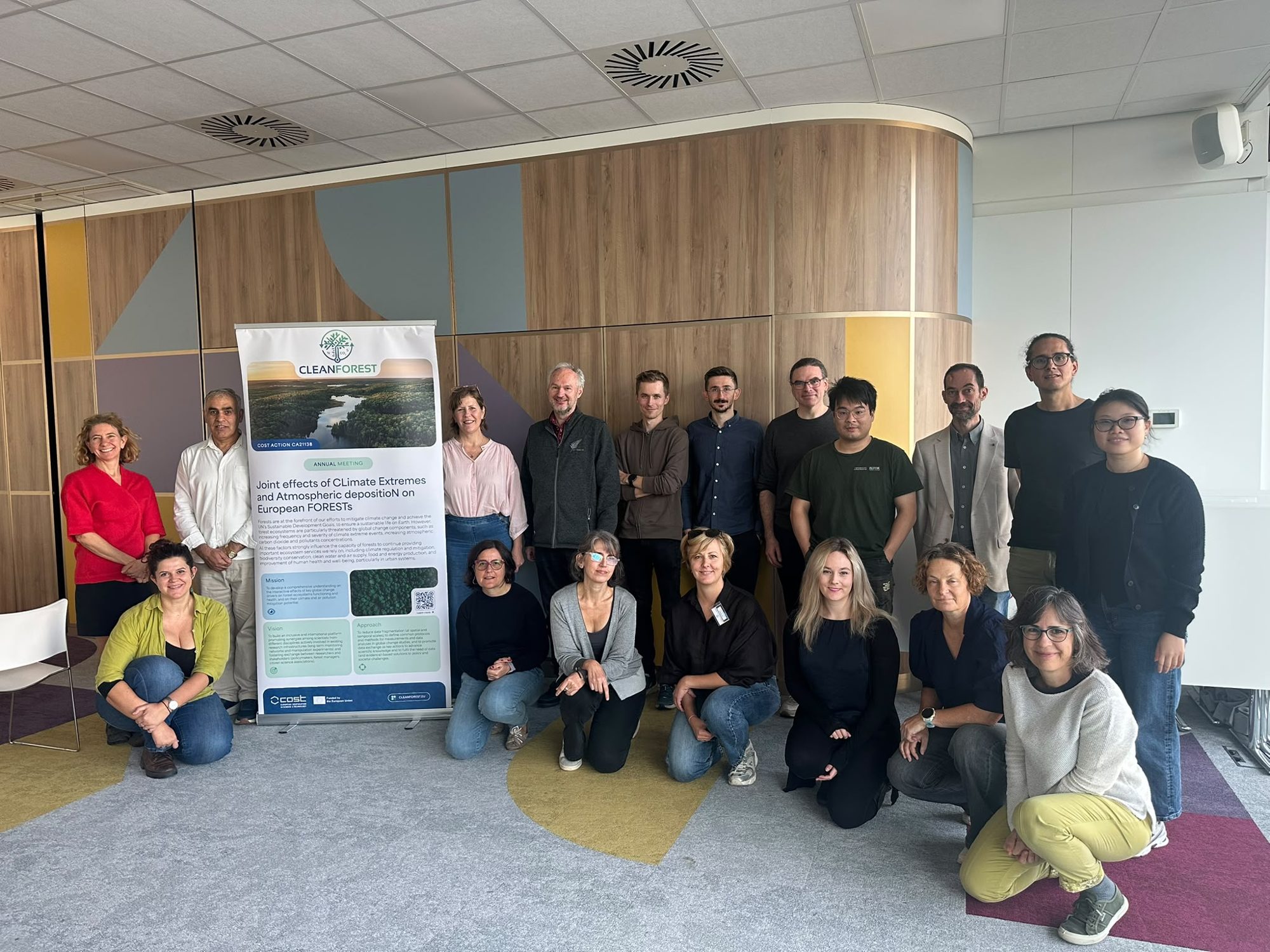
On 1 October 2026, the CLEANFOREST COST Action brought together researchers and stakeholders in Brussels, with additional participants joining online, for the event European Forest Resilience: From Evidence to Action and Future Priorities.
The event provided an opportunity to share key findings and resources developed through CLEANFOREST’s collaborative activities, including evidence on changing environmental pressures, forest responses to global change via long-term monitoring and manipulation experiments, gaps in current monitoring approaches, and practical resources to support forest monitoring and management. Results from a questionnaire exploring stakeholders’ needs and priorities for forest monitoring and management were also presented, alongside a practical decision-support framework for tree species selection across European biogeographical regions for maximizing climate and N mitigation led by Lora Stoeva and Anastazija Dimitrova.
Representatives from FAO, the European Commission’s DG AGRI and ICP Forests, alongside forest managers and other stakeholders from Greece, Slovakia and North Macedonia, participated in an open dialogue on how scientific evidence can better support forest policy and practice.
Four key messages emerged from the discussion moderated by Line Nybakken and Andrei Popi, with Kuba Jelen and Caitlin Lewis as rapporteurs:
1. Making scientific evidence more accessible and relevant to policy and management. Stakeholders highlighted the value of scientific reviews and syntheses that provide clear, concise, policy-relevant messages. Particular emphasis was placed on identifying which indicators and monitoring approaches are most informative for assessing forest condition and resilience, and how scientific findings can support European and international policy commitments.
2. Addressing critical knowledge gaps in forest responses to global change. The discussion highlighted the need to better understand interactions between climate extremes and biotic pressures, particularly pests and diseases. Other important gaps included the responses of non-dominant trees, natural regeneration and the effectiveness of different forest management approaches, including continuous cover forestry, in supporting adaptation to climate change.
3. Strengthening the connection between research, monitoring and forest management. Participants stressed the importance of translating scientific findings into practical guidance that reflects the challenges faced by forest managers. Improved monitoring, including more informative indicators of regeneration and forest resilience, was identified as essential for supporting management decisions under changing environmental conditions.
4. Moving towards genuine co-creation of knowledge. Stakeholders emphasized the need for accessible communication, intuitive visualizations and practical knowledge exchange, including field-based activities. Importantly, engagement should not be limited to disseminating research findings: stakeholders should be involved throughout the research process, from identifying priorities to developing and applying solutions. Living labs and other participatory approaches were highlighted as valuable opportunities for strengthening this two-way exchange.
The dialogue highlighted a shared priority for future initiatives: moving beyond communicating scientific results towards co-developing the knowledge, monitoring approaches and practical solutions needed to support resilient European forests.
A sincere thank you to all participants for their valuable contributions and for helping identify priorities for future collaboration!